
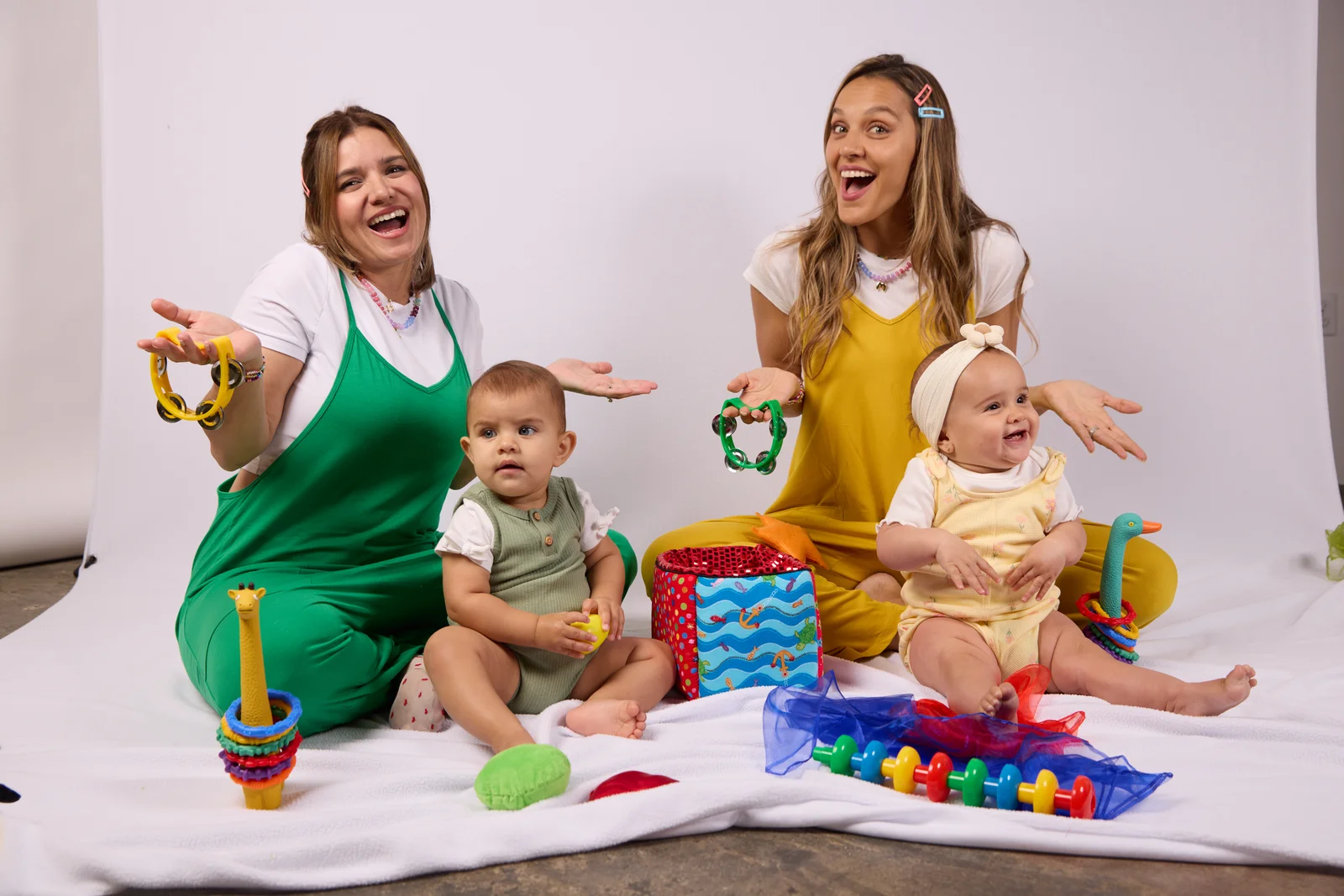
My mom is Argentine, my mother-in-law is Colombian, and between the two of them they sang almost every song from my childhood and from my daughters' childhood. In Doral there are so many families we run into at the grocery store sharing the same songs, even when we come from different countries.
Spanish-language nursery rhymes are one of the biggest cultural gifts we can pass to our babies. You do not have to be a singer. You do not have to have a perfect accent. You just have to sing them. Here are the ones we sing in class and at home, with the lyrics, when they work best, and something I learned singing them to my daughters.
1. Aserrín, aserrán
Aserrín, aserrán, los maderos de San Juan, piden pan, no les dan, piden queso, les dan hueso, y se les atora en el pescuezo.
You sit your baby on your legs facing you, rocking back and forth on the beat of the rhyme. My mom sang it to me at home, and now I sing it to my two daughters. Works from three months old with full support, and around nine months they begin to anticipate the movement.
2. Tortitas, tortitas
Tortitas, tortitas, tortitas de manteca, tortitas de cebada, para papá que come y calla.
You gently clap your baby's hands while singing. If they are not clapping on their own yet, you guide their hands with yours. This rhyme works beautifully between six and twelve months, right when babies start coordinating claps.
3. Pinpón es un muñeco
Pinpón es un muñeco muy guapo y de cartón, se lava la carita con agua y con jabón.
This one is perfect for bath time. You sing it while you wet their face, soap their cheeks, dry them with a towel. It becomes the bath song, and your baby starts associating the melody with that routine. After a few weeks, when you start singing Pinpón, your baby already knows water is close.
A song is the first mother tongue your baby understands.
4. Cinco lobitos
Cinco lobitos tiene la loba, cinco lobitos detrás de la escoba, cinco crió, cinco cuidó, y a todos cinco tetita les dio.
You take your baby's hand, show them the five fingers, and touch each one as you sing. Works from four months, when they start noticing their own hands, and keeps working until two years old when they count along.
5. Sana sana
Sana, sana, colita de rana, si no sana hoy, sanará mañana.
The universal song of the kiss on the bumped knee. Your baby learns very fast that when something hurts, you come with this song. Around a year old, many babies start singing it in their own way when a stuffed animal "falls". By two, kids sing it to their toys.
6. Los pollitos dicen
Los pollitos dicen pío, pío, pío, cuando tienen hambre, cuando tienen frío. La gallina busca el maíz y el trigo, les da la comida y les presta abrigo. Bajo sus dos alas, acurrucaditos, hasta el otro día duermen los pollitos.
It is long, sweet, and the most-sung lullaby across Spanish-speaking homes. If you sing it every night after the bath, in a week your baby links the melody to sleep. It is a trick worth gold at three in the morning.
7. Que llueva, que llueva
Que llueva, que llueva, la Virgen de la cueva, los pajaritos cantan, las nubes se levantan, que sí, que no, que caiga un chaparrón.
For Miami's many rainy days. You sing it looking out the window, and rain becomes a fun event instead of a confinement.
8. Saco una manita
Saco una manita, la hago bailar, la cierro, la abro, y la vuelvo a guardar. Saco la otra manita, la hago bailar, la cierro, la abro, y la vuelvo a guardar.
Beautiful for working on hand coordination. You sing, you model the gesture, your baby copies. By nine months many babies copy the "open, close".
If your Spanish is not perfect, it does not matter. Your baby is not grading your accent. They are absorbing the rhythm.
How to use them at home without pressure
One idea that worked for me, one rhyme per activity, repeated several times a day. Aserrín when I lift her up, Pinpón in the bath, Los pollitos before sleep, Sana sana when she falls. With repetition, your baby starts anticipating the rhyme when they see the activity, and eventually starts singing them on their own.
If your Spanish is the kind that understands a lot but speaks little, the rhymes are your way of loosening the tongue. They wake up your ear. Your baby will hear you hesitate the first time, and by the fourth time you know them all. It is a Spanish class without trying.
At My Tribu we sing several of these in class, and we add original songs we wrote for this community. If you want to see what a class looks like, Lau walks through it in another note. If you want to come sing with us, your first class is free. We will see you on the lawn.